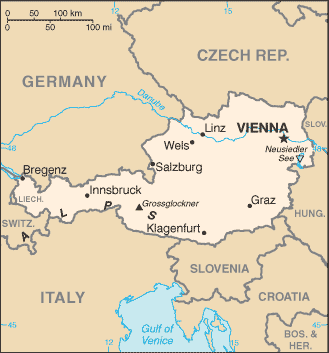
Over the years, Austria has been facing much adversity as a nation. Various professionals seem to be expecting much more productivity out of a country with such a high reputation. However, no one can denounce these opinions because currently Austria is considered a first world country that continues to face major setbacks in becoming a further stabilized nation. With this in mind, what can be the fundamental cause or several underlying causes of its numerous social, political, and environmental problems? Can the setback, or setbacks, lie within the notable annexation with Germany during the world wars, or did the impeding factors emerge after Austria became an independent nation?

Lingering effects from Communist rule is quite a possibility when dealing with a nation that had such close ties with a powerhouse house nation such as Germany. During the era of the world wars, European nations dealt with incredible changes that corrupted any sort of productive movement towards independency. Globalization of Austria was halted due to Germany’s total command of the region. Austria maintained little to no control over their domestic issues which led to far greater troubles in the long run. Today, we can see these issues on much greater levels partially due to the insufficient priorities they set within their nation. The mix ups in priorities can be seen within major intraregional problems such as the inability to regain religious stability within their nation following the ban of organized religion under Communist rule. With more than 75 percent of Austria practicing Roman Catholicism today, can solutions be reached through a unified persistence of finding proper, religious-minded solutions to the nation’s various disputes?
David N.